Laser welding
Handheld and automated fibre welding cells for fabrication and repair.
Products
Our core lines: continuous wave for heavy rust and coatings, pulsed for precision work, and a handheld marker for traceability. Beyond these, we source and export the complete laser range of our manufacturing partner — welding, cutting, automation — under one quotation and one point of contact.
Two cleaning families and one marker. Continuous wave at 1,500 / 2,000 / 3,000 W — water-cooled, 10 m delivery fiber, 5–300 mm scan width — for production-scale rust and coating removal. Pulsed at 100 / 200 / 300 W — air-cooled, 25 kg trolley, M² below 1.8 — for moulds, tooling and thin sheet.
Line 01 · Continuous wave
For work that has to keep up with a production schedule: hull plates, structural steel, tank shells, tower sections. At 3 kW, the comparison stops being laser versus sandpaper and becomes laser versus a blasting crew with its containment, disposal and permits.
3 kW continuous wave — rust removal in a single pass.
| Parameter | Specification |
|---|---|
| Laser power | 1,500 / 2,000 / 3,000 W |
| Laser type | Fiber, 1,080 nm |
| Power adjustment | 10 – 100 %, gradient adjustable |
| Power stability | < 5 % (3 kW unit) |
| Scan width | 5 – 300 mm, continuously adjustable |
| Delivery fiber | 10 m standard; 15 / 20 m optional |
| Cooling | Water, integrated chiller |
| Supply | 220 V 1-phase (1.5 / 2 kW) · 380 V 3-phase (3 kW) |
| Weight | ≈ 190 kg cabinet · 1.9 kg cleaning head |
Full datasheet and third-party CE test reports on request — see Compliance.
Line 02 · Pulsed
For work where the substrate matters more than the speed: moulds, tooling, thin sheet, weld seams, coated parts. The layer comes off; the base material does not change colour, warp or anneal.
For this line, export classification is settled in writing before a quotation is issued — see Compliance.
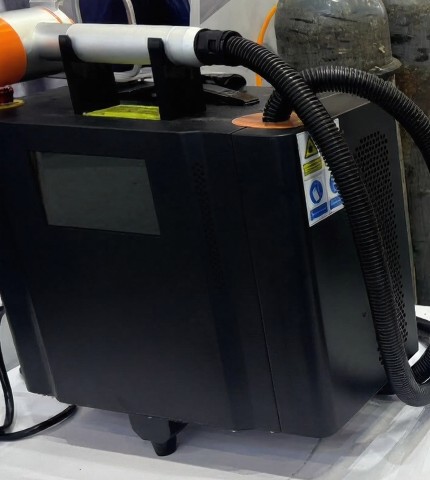
| Parameter | Specification |
|---|---|
| Average power | 100 / 200 / 300 W (500 W on request) |
| Pulse energy | up to 1.5 mJ |
| Pulse width | 150 – 190 ns, adjustable |
| Beam quality | M² < 1.8 |
| Repetition rate | 5 – 200 kHz |
| Scan range | 0 – 150 mm · 8 modes · 3,000 – 10,000 mm/s |
| Delivery fiber | 3.5 m |
| Supply | AC 100 – 240 V, < 750 W |
| Weight | 25 kg machine · 1.0 kg cleaning head |
Full datasheet on request with the quotation.
Line 03 · Handheld marking
A laser marker you carry to the workpiece — or dock into its stand and use as a bench unit. One tool covers tooling identification, nameplates, serial and UDI traceability, signage and metal engraving, without fixtures or a dedicated marking bay.
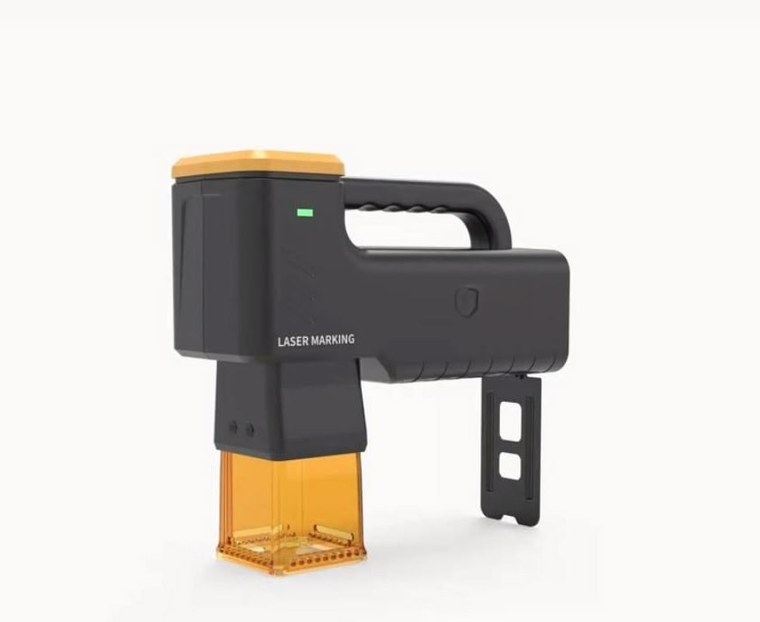
Full specification and lens options on request.
Beyond cleaning & marking
Through our manufacturing partner — a laser group in continuous operation since 1971 — we also export complete equipment lines. Same quotation discipline, same documentation pack, same point of contact.
Handheld and automated fibre welding cells for fabrication and repair.
Fiber sheet-cutting machines and tube-cutting systems for metal fabrication.
Bench and inline marking stations for traceability and branding at volume.
Five-axis drilling and cutting systems for aerospace-class geometries.
Robotised laser cells and custom automation lines, configured per application.
Any of the above under your brand — see OEM for how the programme works.
Options
The difference between selling a machine and supporting a fleet.
Protective windows, nozzles, focus optics and seals — priced, with a lead time per item.
Local extraction at the head for paint and coating removal.
Flange, cabling and I/O for integration into an automated cell.
Parameter setting by substrate, plus a maintenance routine the operator can follow.
Manual, maintenance schedule and the technical file for EU market access.
Housing colour, decals and manual branding for private-label programmes.
To quote
State the power and the substrate. We reply with the configuration, options and indicative pricing.
Request a spec sheetFAQ
The answers we give on the phone before a quotation is written.
Working mode, and therefore the job each one is for. Continuous wave delivers constant power into the spot — fast, broad coverage, built for rust, paint and mill scale on thick steel. Pulsed delivers short high-energy pulses with low heat input — slower per square metre, but the substrate is untouched, which is what matters on moulds, tooling, thin sheet and weld seams.
The 3 kW continuous wave unit. It is the configuration where laser competes with a blasting crew on cost per square metre rather than with sandpaper, and it is the one already white-labelled by a UK machinery distributor for its own fleet customers.
The 100–300 W air-cooled pulsed line, with 500 W available on request. Pulse width is adjustable from 150 to 190 ns, pulse energy reaches 1.5 mJ, and beam quality stays below M² 1.8 — enough to strip a layer without annealing or distorting the part underneath.
The 1.5 kW and 2 kW continuous wave units run on 220 V single phase; the 3 kW unit needs 380 V three phase. Both use a water-cooled source with an integrated chiller. The pulsed line is air-cooled and runs from a standard wall socket — no chiller, no coolant to maintain.
Continuous wave: a cabinet of roughly 190 kg with a 1.9 kg handheld head on a 10 m delivery fiber, 15 or 20 m optional. Pulsed: a 25 kg trolley with retractable handle and wheels and a 1.0 kg head, so it can be taken to the workpiece. Neither is a backpack unit, and we do not describe them as one.
Yes. It is a handheld laser marker for nameplates, traceability marks and signage — carried to the workpiece or docked as a bench unit. It is supplied alongside the cleaning lines, not as a substitute for them.